
Remarks by Associate Tenant, Professor Dan Plesch at an event marking the anniversary of the opening of the Nuremberg trials in 1945, also addressed by international barrister Kirsty Sutherland and sponsored by 9BR Chambers at the British Institute for International and Comparative Law where Plesch is a Fellow.
The immunity, or lack of it, of Heads of State from bi-lateral international criminal liability is a vital issue in global justice. International courts and tribunals dating back to the International Military Tribunal at Nuremberg have set aside the idea of immunity in their contexts. Nevertheless, prosecution by the leader of one state by another state is, erroneously, still accepted as not legal as determined by the International Court of Justice in the Arrest Warrant case of 2002. It is in this context that we can consider international legal action before Nuremberg.
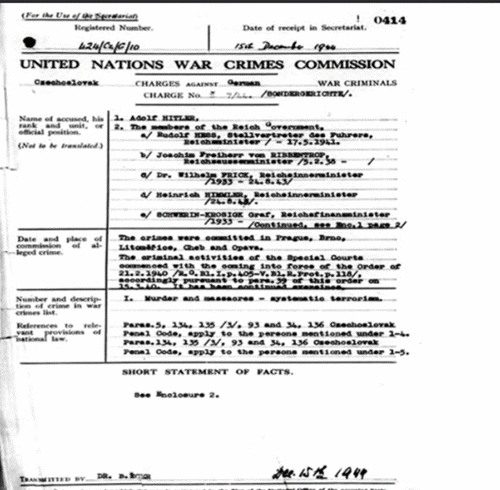
This international criminal charge sheet against Adolf Hitler is dated December 1944 and it is written and typed on a standard form of the United Nations War Crimes Commission. It was written in London, where Nazi V2s -Scud type ballistic missiles – were detonating at random. In Belgium, the Nazis were preparing what we now call the Battle of the Bulge.
On this Charge Sheet against Hitler and his officials, the accusing state is Czechoslovakia using evidence sent by resistance fighters at home and focused on illegal courts introduced by Hitler.
The serial numbers show that it is one of hundreds of indictments being considered; and not treated differently because a Head of State is on the Charge Sheet.
In the box on the form; the Czechs specify the international and domestic laws that Hitler and his subordinates are accused of violating: Murder and Massacres is first. It is taken from the 1919 Versailles list of war crimes accepted by Germany and Japan and so having prior validity, and acceptance by the accused’s state
This bilateral charge of the Czechs against Hitler was endorsed by 16 Allied states: including the United States which we know had had a dissenting opinion on the Kaiser.
Hitler was then listed as an accused war criminal liable to arrest by any member state.
But: Hitler was not accused by the Commission itself, as this was outside its remit. There was no requirement that if arrested Hitler had to be turned over to an international body. It did not exist.
At this time, in the winter of 1944, the IMT was a distant dream as the major powers had yet to determine how to implement the 1943 Moscow agreement on the major criminals.
The UNWCC’s member states acted to fill this political and legal space. They developed an advisory opinion on whether Heads of State had immunity. They determined that in the case of the major crimes being committed in wartime by Hitler and other leaders, it did not.
Several arguments that weighed with the states and their representatives. Peacetime immunity did not apply between belligerents; those giving orders were logically as responsible as those implementing or assisting them; that the whole point of dictatorships was that the dictator gave the orders; and the severity of the crimes; these
The UNWWC considered over the winter of 1944 whether the 15 charges presented to it by three European member states - amounting to a bundle of 2,000 pages of evidence - met the evidentiary standard of a pre-trial process. They did. Charges against Mussolini were also supported.
We should note Mark Ellis’s key work determining that the UNWCC achieved good standards of fairness in its advisory opinions; its assessment of the indictments presented to it; and, that in the 2,000 domestic trials it supported - including the subsequent proceedings at Nuremberg and the ‘murder of seamen’ trial currently in the news, the number of acquittals was considerable by modern domestic and international standards. This was no kangaroo court process exercising victor's justice. Bombardment of cities of military value was not considered criminal so that Allied bombings of Germany and Japan were exempt, but so too were the bombings of London by the Luftwaffe.
The formal multilateral diplomatic body that was the UN War Crimes Commission, in its well known 1948 History published by HMSO, explained its consideration of the Head of State immunity. And its decision to discard as irrelevant ideas of the immunity of Heads of State in respect of international crimes. During the war its decisions were sealed –but this general policy was public.
The St James’s declaration of 1942 of the nine Allied Powers on Punishment for War Crimes made clear that those giving the orders were liable without exception to prosecution. National leaders of the Allies made repeated statements on these lines giving early and prior warning that retributive justice for those ordering, implementing and assisting in war crimes was a major war aim of the Allies. For example, the US President Franklin Roosevelt responded to the ousting of Mussolini by stating publicly that just because Mussolini had left office he should not expect to escape justice.
Let’s consider a little more the validity of the state practice embodied in the UNWCC. According to Cassese, the UNWCC is a source of authority in international law. His view is not surprising. National representatives to the UNWCC included a former President and several members of the permanent international court at the Hague - Renee Cassin, Andre Gros and SIr Cecil Hurst amongst them.
FDR sent Congressman Ambassador Herbert Pell, advised from Harvard by Sheldon Glueck - mentor of Ben Ferencz. UNWCC member states included China, India, France, the UK, the US and many now members of the EU.
Poland, which was a leader in these diplomatic and legal efforts in the 1940s, held a commemorative event on the UNWCC anniversary in 2023 addressed by the ICC President, and made a submission reminding the International Law Commission of its indictment of Hitler.
In 2024, Then President Assad of Syria faced criminal charges for gassing people including French citizens before the French courts. The Court of Appeal in 2024 apparently accepted the WW2 cases I had researched and referred the case to the Supreme Court, the Cour de Cassation.
I provided a memorandum to the Cour that documented the policy of the French government in the 1940s on the issue of Head of State immunity, including the precise dates on which the Commission reached its decisions and the statements and decisions of General De Gaulle, Renee Cassin and Andres Gros.
The French court's own Rapporteur noted the existence of the WW2 cases in relation to the personal immunity of serving Heads of State. Nevertheless, the Supreme Court determined, without any explanation or discussion of the evidence before them, that no such past practice existed at all. And that serving Heads of State were entirely immune from prosecution by another state even for the most serious crimes.
However, now that Bashir al Assad has left office he is, the court said, liable to charges under functional immunity. This upside down decision offers no hint of redress to victims of realtime crime, and incentive to the leader to remain in office so as not to become a criminal on leaving office.
Nevertheless, the Cour’s invitation to bring fresh charges under functional immunity for past Heads of State pushes the immunity defence back further.
At a minimum today, the pre-Nuremberg cases against Hitler support the ICC’s work in holding serving Heads of State to account. It is argued that this is an innovative law. Not so, as is now fully documented, the Allied powers, determined that serving Heads of State had no immunity for international crimes.
More usefully they provide a substantial base of state practice for nations today to take up bilateral charges against foreign leaders who have committed major crimes. Taken together with the expansion of state practice on universal jurisdiction, it is beyond time that more ‘Kings’ understood they will be held to account
80 years ago the UNWCC provided the social, diplomatic, scholarly and legal context that shaped the Nuremberg Charter. FDR’s Ambassador Pell presented a definition of Crimes Against Humanity in March 1944, more than a year before the famous meeting of US Justice Jackson and Lauterpracht in Cambridge. In 1945, the French, British and other allied officials engaging with the emerging IMT were part of the UNWCC process.
This is not to downplay the jewel in the crown that is the IMT, but rather to put it in context of other gems of legal action, and of public concerns. The accountability of Doenitz at Nuremberg, the establishment of Crimes Against Humanity and the Crime of Aggression all were made in the context of Allied policy led by FDR and the refugee governments in London. And they echoed public mood.
For example the 1944 Hollywood movie None Shall Escape portrayed a future war crimes court sitting in Poland including judges from Africa and Asia, something hard to imagine for Hollywood today which has cancelled all participants except the US.
But by the later 1940s, FDR - a leader of International Criminal Justice, was reviled and his new deal democratic socialist agenda discarded.
By early 1945, anti-semitic and pro German officials in the State Department secured Herbert Pell’s removal and the British of Sir Cecil Hurst for pursuing Crimes Against Humanity and an International Criminal Court.
Pell, outside the government, spoke out and organised. He became a key figure in forcing the Truman Administration to act on a war crimes trial. In a fractious press conference, the Secretary of State was forced to confirm FDR’s policy of German on German crimes- Crimes Against Humanity. Then the Truman White House had to rush an announcement that Justice Jackson was on his way to London to head off Pell’s public detailing of inter-agency perfidy.
Even then, once in London, Jackson explained to the UNWCC that unless he reached agreement with the Allies, the US itself would only concern itself with crimes committed against American troops. Not what FDR and Pell had worked for. Nor indeed what the US Army later conducted with Telford Taylor.
So, if one looks at agency and institutions on the war crimes issue in the Arenas of London and Washington in the 1940s it is hard to escape the conclusion- No Pell, No Nuremberg, at least not as we think of it today.
To conclude, the state practices associated with the UNWCC on the liability of serving Heads of State for prosecution by individual states have standing as state practice. Unfortunately, there is much ignorance, willful ignorance and a willingness to place power over law. But we are intent on holding power accountable, we will have no Divine Right of Kings, not least because our ancestors discarded such a notion as irrelevant.
Dr Dan Plesch is Professor of Diplomacy and Strategy at SOAS University of London, author of Human Rights After Hitler and an authority on the United Nations War Crimes Commission of 1943-48 contributing to publications, project and new and documentary media.